
↳ Mission & Values
↳ Meet the Editors
↳ Submit!
Fall 2025
Spring 2025
Winter 2025
Archive
Follow Us
The Spotted Lanternfly: A Question About Narratives
Manuela Guzmán
→MFA ILLU 2026
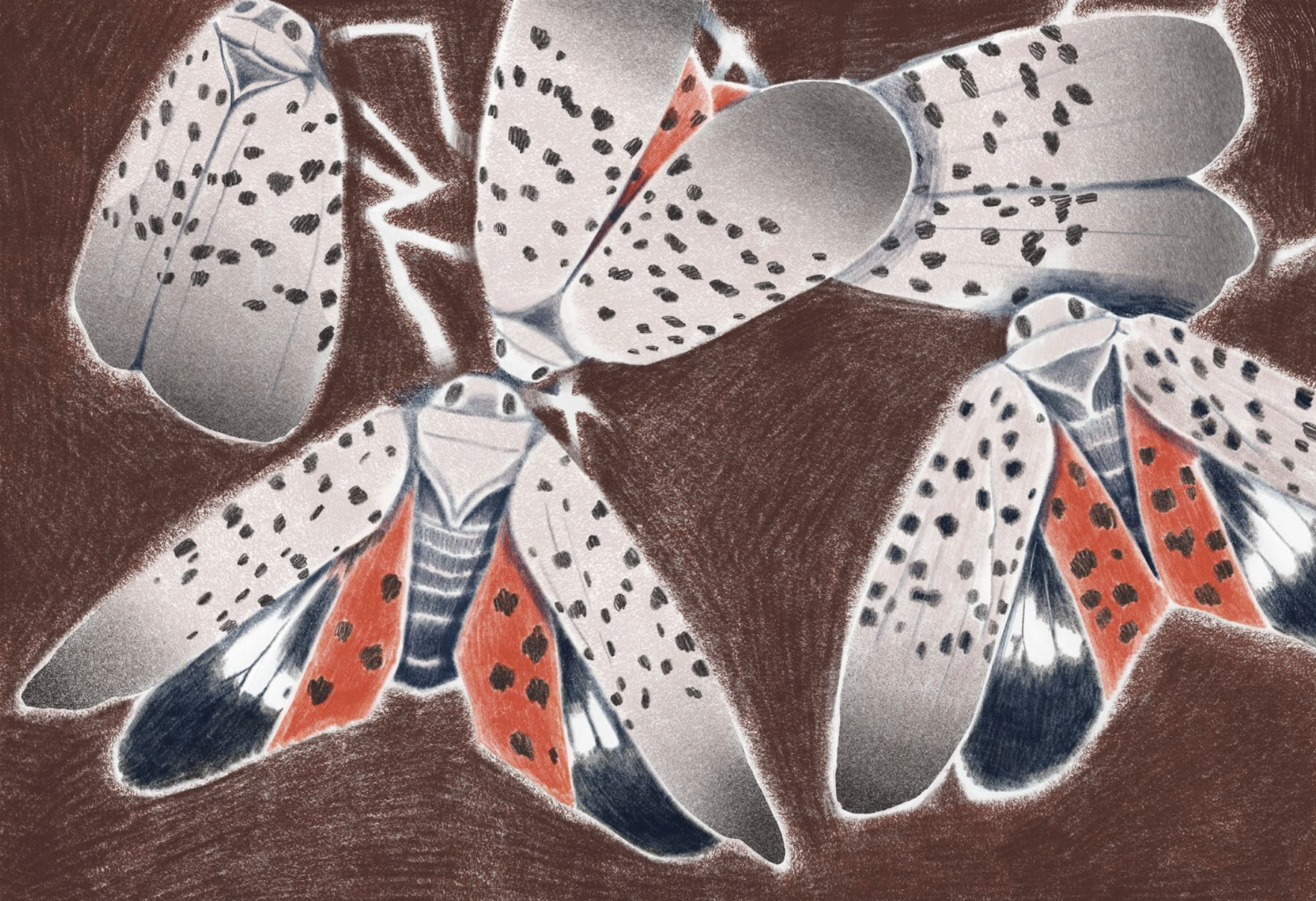
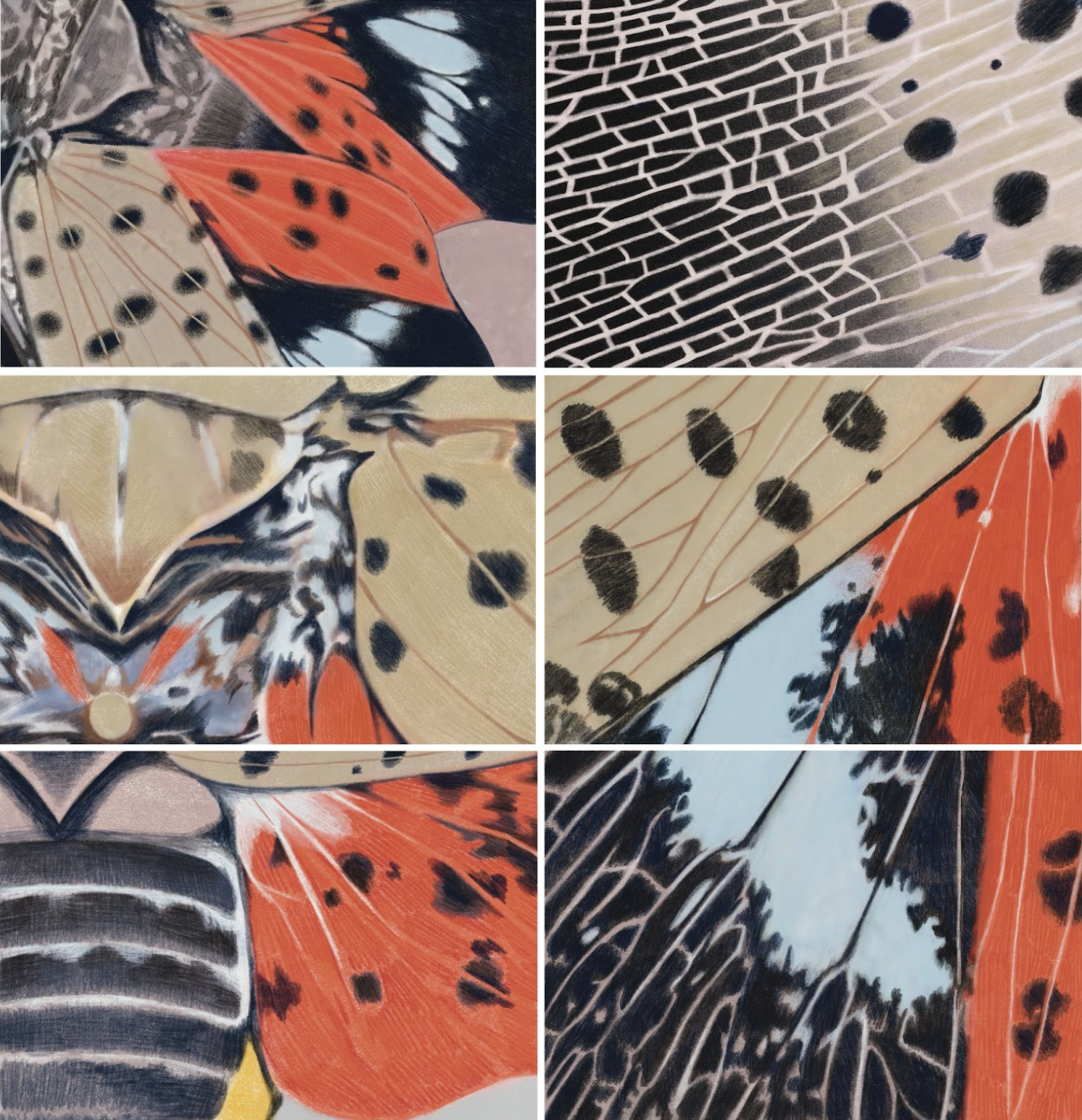
Since I arrived in the United States a year ago, I have noticed in the summer how the streets are filled with tiny grey and black creatures. As I get closer, they jump and open their wings, revealing a bright red color.
These insects, called spotted lanternflies, look harmless, but are in fact an invasive species, as many of us now know. They feed on hardwood and fruit trees, weakening the plants, limiting their growth, and leaving them vulnerable to disease and sooty mold. This not only poses a threat to native species but also a problem for farmers (they sucks the sap of grapevines, for example).
For this reason, people are killing the spotted lanternflies, and many of my encounters have been with their crushed bodies on the pavement while walking on the street.
It is interesting how insects can awaken in us a kind of rejection that we don’t feel with other animals. Their size and appearance make it hard for us not only to relate to them but to recognize them as sentient beings. Historically, insects have been associated with disease or death, and often, if we connect with them at all, we find that insects represent the worst, most monstrous aspects of humanity.
Our inability to recognize insects as sentient beings reinforces an already present duality that separates humans from nature. Insects represent a third of all living creatures on the planet, and their role is vital for the environment’s conservation. Pollinators or decomposers are direct examples. Wouldn’t rejecting them contribute to a disconnection from our own environment and its protection?
In a conversation with an entomologist, I was told that prompting people to kill the lanternflies has been the best option to control their population, since other solutions pollute and further imbalance the ecosystem. Clearly, behind the act of killing the lanternflies, we intend to conserve the environment and protect native species that have been historically threatened as well by colonialism and globalization.
Although I understand all of this, I keep hearing conversations that describe the spotted lanternfly as “evil” and seeing people run after them to kill them, ignoring the weight of what killing another being could mean. A narrative of an “evil invader” surrounds these insects, when they had no intention of arriving here themselves.
It is believed that the spotted lanternfly, first seen in the US in Pennsylvania, was introduced by accident on a stone shipment coming from Asia. Since then, every summer, we get warnings about these creatures with “an appetite for destruction” from the news and social media. However, they, along with many other species, have been brought by people, voluntarily or not, through colonization or trading. Now they have to face death because of it.
I am not willing to dismiss the ecological problem that they create, but I wonder if taking care of our surroundings and the creatures we care about could go hand in hand with a narrative that doesn’t imply antagonizing what comes from the outside. I wonder how we can find alternatives that don't portray the victims of the same system that is destroying the environment as evil.
In a country that has witnessed so much violence around “who belongs and who doesn’t,” shouldn’t we question this mentality around any life form? Don’t these narratives of good and evil applied in nature have the potential to reinforce violent narratives within ourselves?
Interdisciplinary scholar Banu Subramanian has pointed out that the terminology we use to describe foreign plants and animals is very similar to the one we use to describe foreign humans (immigrants). And in both cases, we frame them as a problem without questioning the real cause of their presence around us. Why are they here in the first place? Why are they considered a problem?
Maybe questioning the term “invasive” and thinking about other narratives can open a door to new possible ways to interact with introduced and outside species. In the case of the spotted lanternfly, climate change and higher temperatures accelerate their reproduction and possibilities to spread. Could we not consider them as messengers of a wider picture of the environmental crisis?
Talking to different people about these questions, I have gathered different perspectives on these insects. Someone, in response to a lack of predators, told me they would consider themselves their predator, acknowledging the act of killing. Some entomologists see them as an opportunity to learn, by practicing pinning, or as food, by feeding them to other insects such as praying mantises and ants.
Ultimately, my question is: how can we recast our relationship with the spotted lanternfly, not to mention so many other “invasive” species—the Asian carp, the Joro spider, the hammerhead worm, the jumping worm?
Couldn’t we use our imaginations to question and resist the terminology and dividing narratives around us? Can imagination open an alternative way to reframe our relationship with our surroundings and each other?
Manuela, an artist from Bogotá, Colombia, sees drawing as a tool for connection and belonging with the smallest creatures around her.