
↳ Mission & Values
↳ Meet the Editors
↳ Submit!
Fall 2025
Spring 2025
Winter 2025
Archive
Follow Us
STARCHIVE: Nahom Ghebredngl
Nahom Ghebredngl
→MFA Sculpture 2026
Olivier Mbabazi
→MA GAC 2026
All images were taken by Nahom Ghebredngl
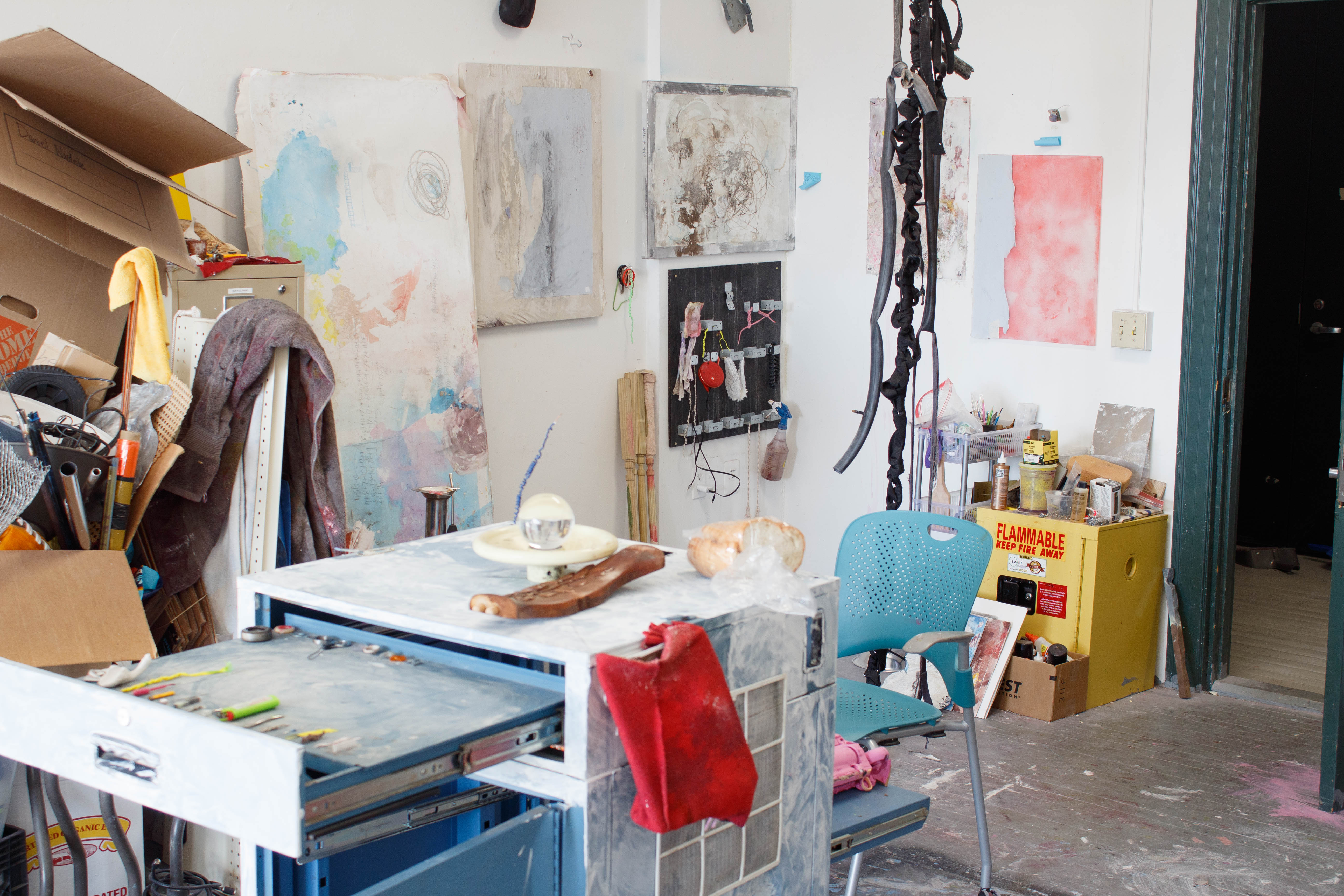
OM What inspires your work?
NG It always starts from the body or the embodied and material. I got my start as an artist working with clay and that still informs everything. While I am not working with clay at the moment, that might change. I am also inspired by the way that you have to listen to the material and imagine somebody touching a functional work. You know when you make a bowl or mug for somebody, part of what you are dealing with is their interface with the work. They are using their hands, sense of smell, and of course their eyes. Hence, I find it interesting to relate my hands and body experience to somebody else’s. When I first started making sculptures, I created heavy, smooth rock-like objects that would sit on somebody’s thigh. While it was fascinating and comforting, a major critique I received was like, “Hey, if this is in a show and somebody picks it up to use it and they drop it on their foot, you are going to have real trouble,” which is quite true. I am also having trouble with interaction in an exhibition setting especially around interrupting the experience. I have been trying to make work that offers a sensation like touching a work without the touching. Here I am reflecting on when I am looking at my work with somebody and they say “I really can feel the coldness or smoothness,” or “This part might be sharp,” and so on. The texture and materiality do a lot to draw a viewer in. Ultimately, my drive is to affect the viewer’s body and offer a place to think into.
OM I like how you make those connections. I perceive what you’re describing as a landscape going from your body to the body of the person interacting with the work. As your MFA is near completion, looking back, was there a time when you realized that you wanted to be an artist? When did you decide to pursue this way of being and doing?
NG Growing up, I did some drawing, but it was not a big part of my life as a child. I was kind of like every kid where you do it for fun, always scribbling in notebooks. But that was mostly because I had trouble paying attention. Up until high school, I was mostly focused on math. Being from an immigrant African family, it was my dad and I together every night, where he was like, “you are going to get good at this and that, and you are going to get really good at math!” I liked math and my undergrad was in computer science. My first experience that was like magic was in my last year of high school, when I took programming and ceramics classes and enjoyed writing code and problem-solving. I had been in the ceramics class for two and half months and was terrible at building stuff with my hands, but it was fun and relaxing. I also had a couple of friends in the course whom I worked with. Then when I got on the wheel, it just felt perfect! I remember feeling astonished by how responsive the material was. Being on the wheel and leveraging the technology—me, the clay, and the wheel—the clay fluidly moved and got into shape. At times it argued with me, which was occasionally painful for my body, but it was really, really, really fascinating to a point that I thought that I wanted to keep doing that forever.
OM That is awesome! Furthering that thought, I will quote the headline in your Instagram bio: “The body is always present.” What fascinates you about the body? And is it always the human body?
NG Like I said, I come from an engineering background. I often think in conceptually structural terms. When I think about the body as it relates to art, its everpresentness has actually very little to do with the body of the artist. The body is always present because it is the thing that is used for art viewing. It is the first interface for experiencing any work of art, right? It is something that every viewer is coming to the work with.
OM I saw your featured piece in the online magazine Inverted Blackness a few weeks ago and I really liked what you said about your identity and Blackness, or what I like to also think of as Africanness. How does that identity inform your work?
NG My relationship with Blackness or with Africanness is that I am a very young immigrant. I came here when I was five. Everything that I know has been moving through my parents. Old stories of a country that existed twenty to thirty years ago. So, my experience with Blackness goes back to the body being everything that everyone brings to the work. There is lots to be said about the last forty years in contemporary art, such as a certain level of education being required to be part of things or to experience work properly. It’s no coincidence that this shift coincides with the bureaucratization of knowledge like earning an MFA, or trying to pull creativity from the working class to the wealthy, when creativity has and always will belong to working people. One may contend that this is an exaggeration, but it is worth saying. I think every kid feels this to some degree, but it is exaggerated by cultural differences. I feel deeply that I want my parents to be able to participate in my work. I want to be able to share it with them and I want to be able to do that without diminishing the work or condescending to them. Hence, what I am after is a sort of egalitarianism to make work that is centrally concerned with how a person’s embodied experience can be activated.
OM How does Blackness speak to you in relation to the practice of making do?
NG Yes, the other side of my approach to Blackness has to do with making do. When everything has been made difficult for you and for people who look like you, there is an imagination in the mind of the oppressor or the ruling class which suggests that if you control people’s means or their living conditions, you might be able to control their spirits. It is not true and it has never been true. Black people, especially in this country, have shown that endlessly. And so when I say making do, it’s not as though material conditions are not crucial. I want to be clear about that. But there is something powerful about using what is accessible to you and to create the very best you can. That is very attractive to me because one of the things that is a surplus in our industrialized society is material—so much junk all around us! So, it is convenient and it is available. Plus I do not have huge funds sitting behind me to buy materials with. So it makes a lot of sense to me spiritually and conceptually to pick up all of the things that have been tossed or anything that interests me and making do. I am interested in what can be produced with scraps.
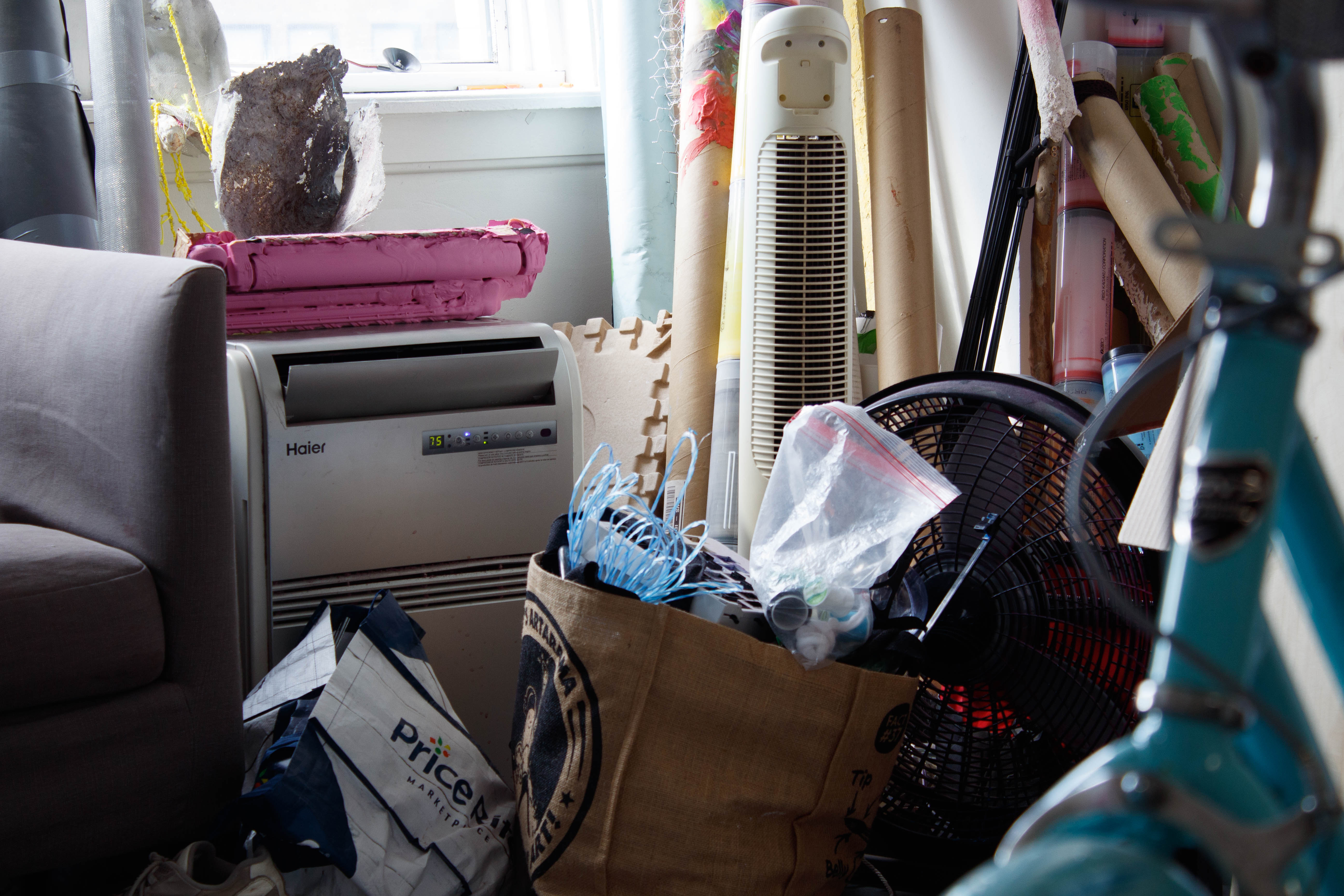
OM That is incredible and I can actually see that accumulation taking shape around here in your studio. I like those connections you make between Blackness or Africanness, systemic injustices, the surplus of stuff in a hyper-industrialized world, and deprivation that persists. When you mentioned making do, I was thinking of Ramesh Srinivasan’s book Beyond the Valley, where he discusses how innovators in places like Kenya practice making do by creatively using limited resources to address technological and social challenges.
Reflecting again on identity, I am thinking of your hybrid or multifaceted identity. As I am sure you know, we are members of such a diverse student community here at RISD, with representation from fifty-three countries. How does being at this institution speak to you in that context? Is this something that you reflect on as you create your work, your career, and your journey?
NG I remember talking about this in my interview to get in here. The major advantage of a place like RISD is that it brings together really talented and determined people. Artists and researchers working here are after it and that is inspirational. I have learned a lot from my peers and that is something that means quite a lot to me. On the other hand, there is a sadness to meeting these many talented individuals and imagining a big pile up of debt behind them. It is expensive to be at a private university in this country. And I know that being an artist does not really pay even if you show your work, even if you build a career. It is hard to build a sustainable life, and that is true even for the less than one percent of folks who manage to do that. You quickly realize that there is a small share of opportunities and a very large pool of brilliant folks. But being in a place where you can actually see the churning out, make friends with twenty or forty wonderful artists, and then look at how many people in the last five or six cohorts have gone on to have a career, is especially painful. And then on another note, institutions in this country, including RISD, with its response to students protesting the genocide in Gaza, have been capitulating in the last couple of years to political influence. That’s a real shame.
OM Is your work political? If so, how and why?
NG That is something I am trying to parse through, but I do not think you can really make work that is not political. If it does not have a political position or a political foundation, it may be used to make somebody else’s political point. I also think that a lot of Black artists can relate to this feeling of not wanting to be pigeonholed and not wanting to have their work be made to clean up the face of an institution or make work that is about Blackness only. So yeah, my work is certainly political and relates to my political focus, which is basically labor and the working people. It seeks to understand and emphasize who actually we are in debt to. It is not those who hold wealth but those who maintain our society. My work sees them not as symbols but as people whose bodies are accumulating material, experience, and breakages. So when I’m creating, I am trying to acknowledge how they have been through a lot of shit, that there is something at stake for them, that their bodies are teetering, but still they are quite powerful and that they cannot be counted out.
OM I’ll quote you again, from the caption of one of your works “a hold for heat, love, and death.” How is that phrase expressed using seven or eight dots of a pink marker on a ceiling?
NG That particular work relates to my ongoing research into these extraordinary Christian mystics in the early fifth century in northern Syria. These guys are pillar saints, sylites, who lived decades of their lives on top of columns, six-by-six foot square, sixty feet off the ground. Their food and waste is being handled by some sort of glorious attendant who is caring for them and sees to their needs. That person is either climbing a ladder or working a pulley system to get them food or to deal with their waste. I am working through these ideas, but I am really interested in these extremely dedicated devotional people. They love deeply, they love their God and they love their community, and that love leads them to suffer the heat of fever. So there’s the heat of their skin, and then the heat of the sun in northern Syria in the summer, right. Sixty feet off the ground, no roof for decades. So their love drives them to suffer heat, and the heat leads them to their death. It’s a simple story about devotion. I just find them endlessly inspirational and quite pitiful and yeah, fascinating.
OM Wonderful! Is there something else about your work or life that you would like to share with our community of readers?
NG Yes, I would like to talk about formal concerns. When I make work, I do have lots of formal concerns about craft, captivating objects and installations, color, volume, and texture. For example, I am making some landscape paintings in the studio right now. Calling them landscapes is hilarious because mostly they are made of glue and plaster. I am really interested in making these surfaces that might ask you to consider them as images first, but as soon as you are done with that, you can sit with the colors and textures. I am layering my sculptures similarly: erasing, diminishing, covering and uncovering, and trying to get different zones of the work to speak to each other.
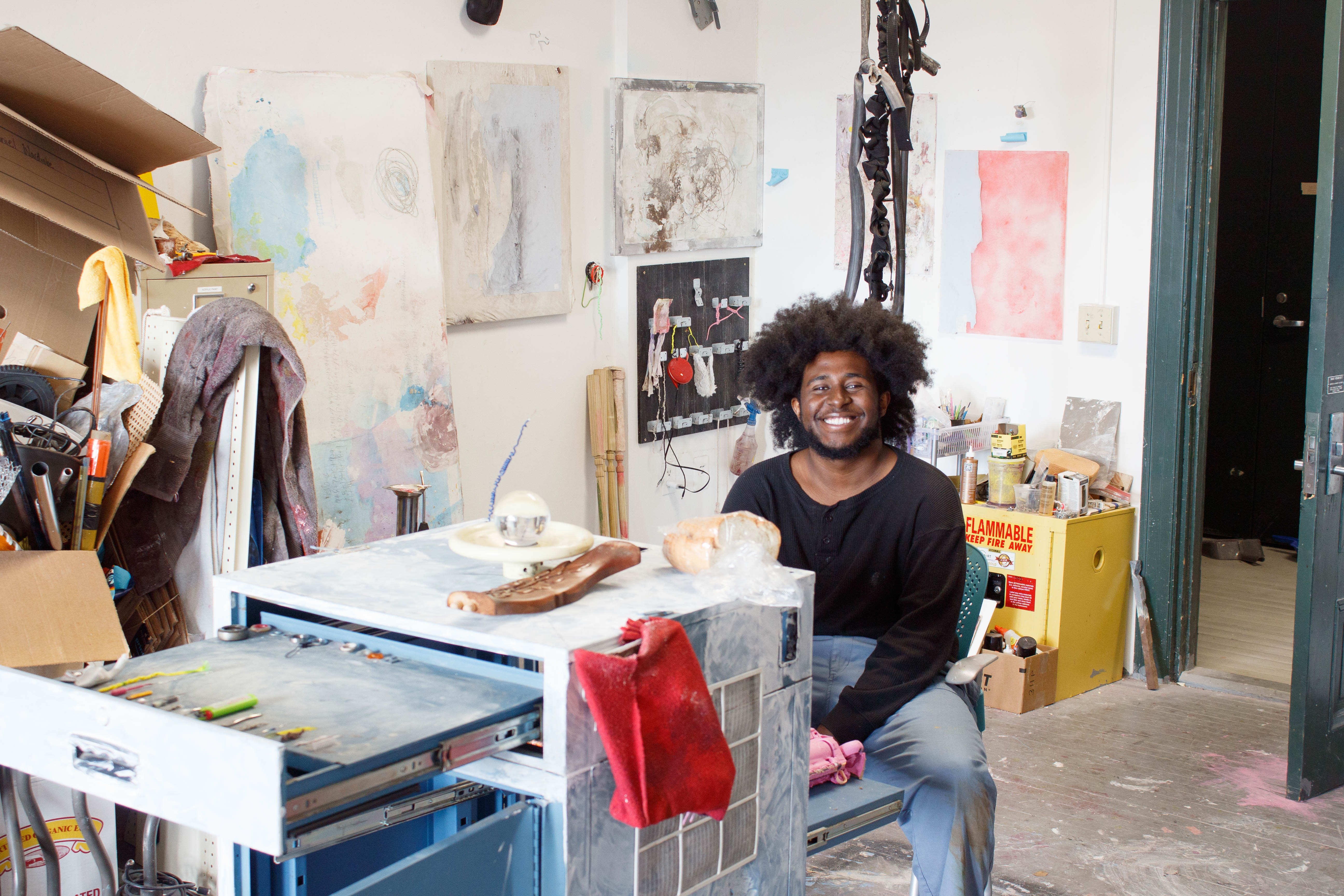
Nahom Ghebredngl is an Eritrean American sculptor and installation artist whose works leverages failure and tactility by creating interfaces for exploring the interpersonal and embodied.