
↳ Mission & Values
↳ Meet the Editors
↳ Submit!
Fall 2025
Spring 2025
Winter 2025
Archive
Follow Us
STARCHIVE: Margot Peer
Margot Peer
→MFA PAINT 2027
Henry Ding
→BARCH ARCH 2026
November 14, 2025, 2:00PM
It’s a piercingly cold day in Providence as I walk into the What Cheer painting studios. Margot’s space is in a corner where two windows on either side filter in sunlight. She greets me spotlighted.
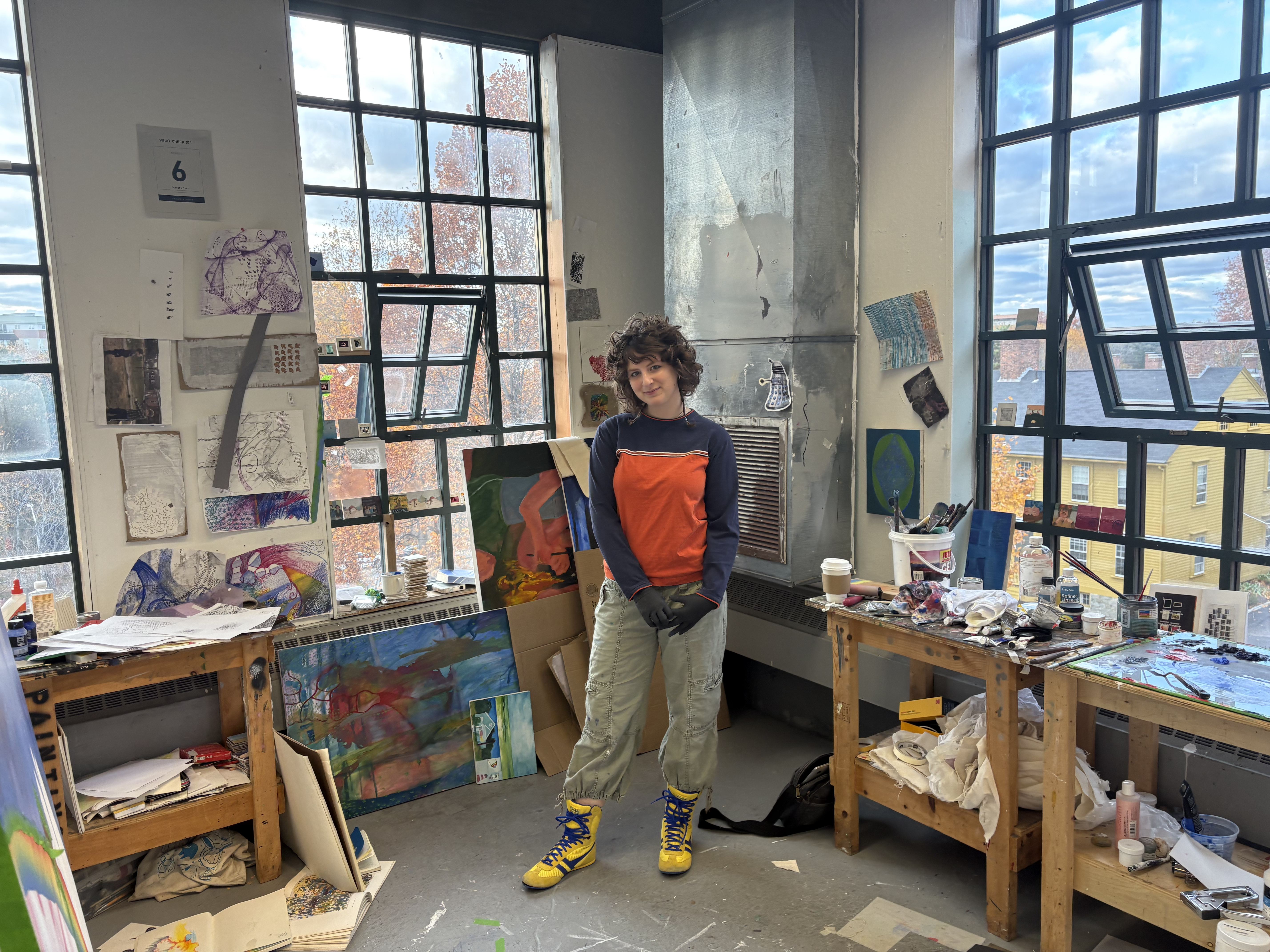
HD What has this year of painting been like for you?
MP Last year, sophomore year, was my first year in Painting. I really went into it kind of not painting, like my first semester I was doing mostly cross-stitch and textiles stuff. But then obviously I’m in Painting, so I started painting alongside my textile practice. Cross-stitching is this super planned thing. You pick the photo, then you make the pattern, and then from that point forward you become automated and do the stitching. I’ve been thinking a lot about automation, like where is my hand in the work?
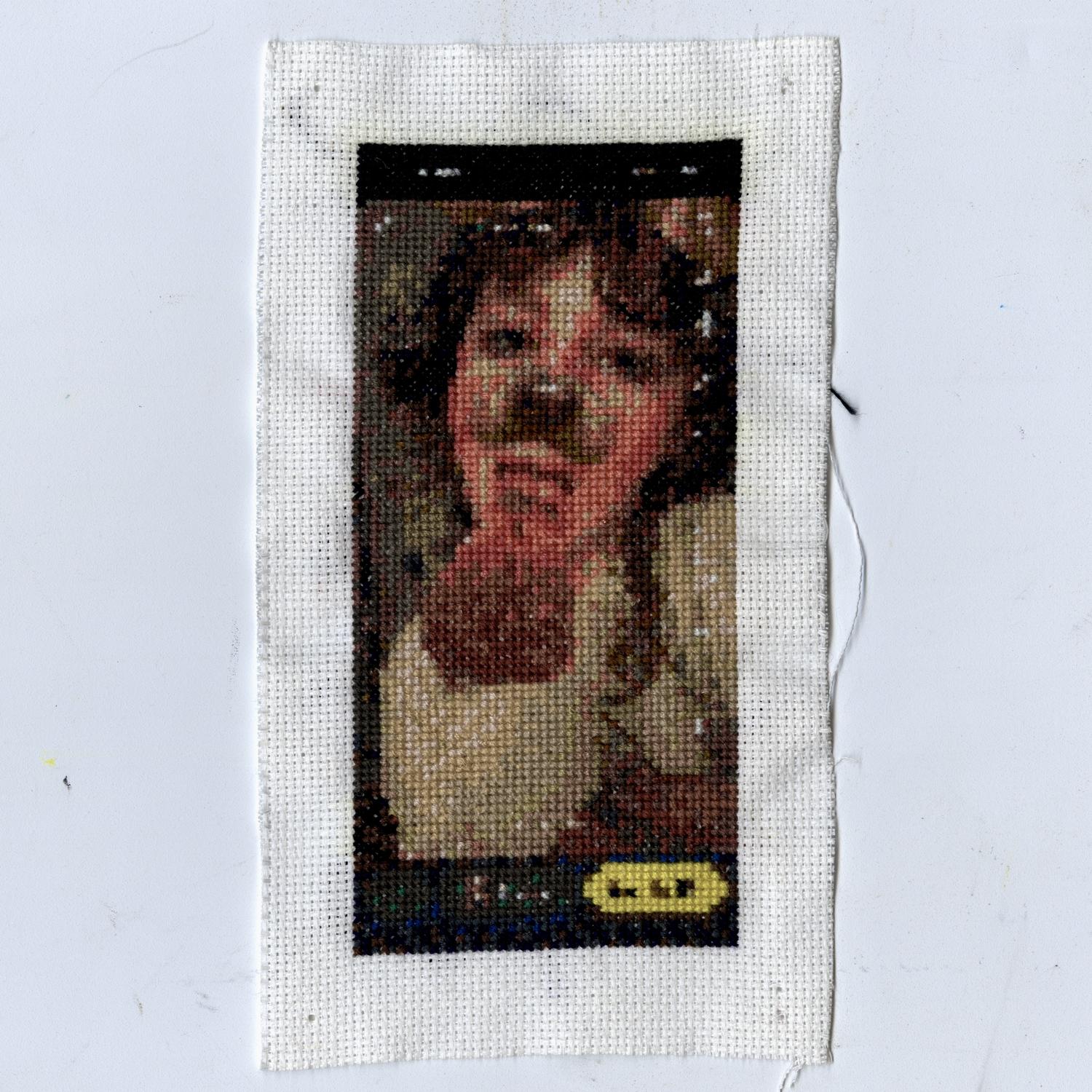
Before meeting, I knew Margot primarily for her textiles work, hyperrealistic pieces clearly influenced by internet culture and digital archives. Self-Portrait, 2025, a cross-stitch piece—was completed with 4,365 stitches.
HD Walk me through your new work, what are you thinking now?
MP I’m thinking a lot about how digital and physical worlds intersect. Recently, I’m having this constant struggle of never having storage on any of my devices, specifically, my desktop. When I don’t have enough storage, the documents will automatically upload themselves to the cloud. They just have this little icon next to them with the cloud and the arrow. I was thinking about this space of the cloud. Like, what is that?
MP Like, we can’t see what the cloud looks like, how it holds space. So I was thinking about the cloud as this third space in between Earth and heaven. Like if Earth is the desktop and if heaven is the trash or death. The cloud is this in-between of the document not being fully dead, but not being really alive either. It’s not on the desktop.
HD Has this interest in the digital world always been something on your mind? What inspires your approach to it?
MP I’ve always liked digital artwork about digital space. But I don’t work with any medium, like coding, through a digital space. I’m not terribly savvy at digital tools. But I’ve always been interested in using digital tools to critique digital spaces. I think things just naturally started to emerge. Especially with cross-stitch work because it’s like this physical manifestation of a pixel. The explicit taking of a digital image into a physical thing. The pixels become thread. They become a physical thing you can touch and hold.
HD Do you view your work, similarly, as a critique?
MP Yeah, I don’t know that I’m critiquing, really. I think these are kind of just imaginings of digital space. I’m not trying to say it’s good or bad.
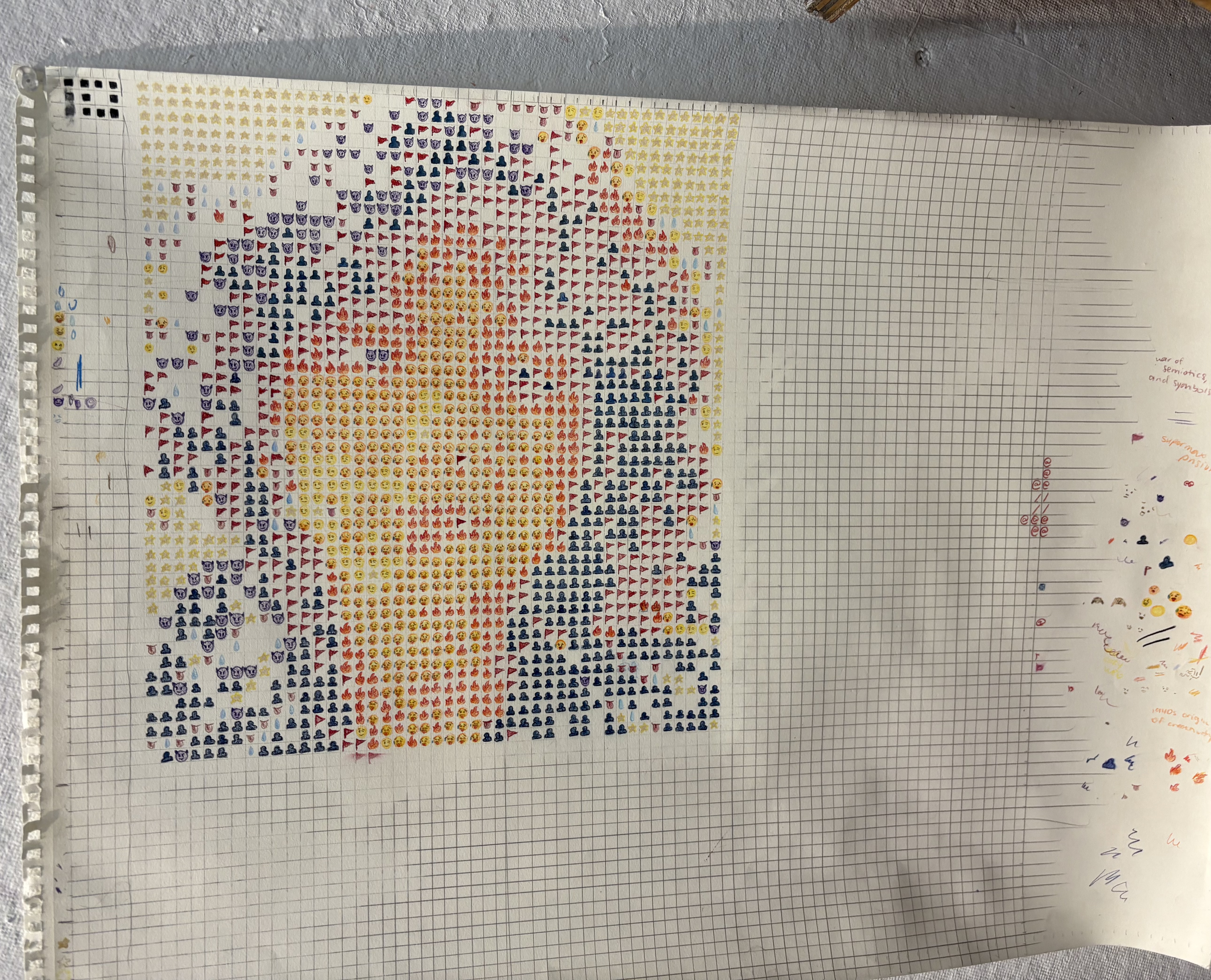
I look up at sketches and scraps pinned onto the wall beside us. Margot takes down a hand-drawn, gridded portrait of a woman’s face made up of emojis.
HD Woah. How long did that take?
MP It took a long time. But it’s the same process of a cross-stitch in the way that you make a pattern. It’s automated in a way. It’s like I’m drawing this many stars and like this many winky faces. But I feel like I’m still trying to introduce the presence of like the hand into this automated process. So having the emojis hand-drawn and grid hand-drawn, it feels like an in-between.
HD I’m noticing it’s all very tactile and material for work about the digital world.
MP Yeah, it’s extremely hands-on. I’m a very material person, which I think sometimes gets in the way of my painting because it’s like traditionally you work with paint on canvas and that’s it.
HD It feels like you’re translating ideas from one place to another.
MP Yeah, I like to take one thing and see how many times I can iterate it. Or like take an image and see how many things I can do with that. Like this idea, it’s like this, but then I could also have a photo of it. I’ll take something that involves my hand and then turn it into something super planned, a little thing that takes forever. Like this a cross-stitch of a drawing. I like to create rules or systems within a single piece and then figure out how I can break out of the rule.
HD Color feels like a big component to the process. I see it in your patterning, textures, and the symbols you’re working with.
MP I definitely think about color a lot, especially where I’m imagining what these spaces look like. I don’t really have a physical picture to color match something to. I have to think through the color, the relation between the color and the ones next to it. I really like blue. I use blue a lot. Yeah, it’s strangely hard. Color seems like it should be a more straightforward thing in painting. But I feel like it’s one of the things I think about the most. Just the choice and the pairing. I mean, you have every color. You could do anything.
HD Do you feel like your paintings right now are an evolution of your cross-stitch work? Or are you still working on both in tandem?
MP I still do cross-stitch, but I don’t do it in studio anymore because I don’t want to get paint on them. It feels like an intense process which I did a lot last year. You kind of really lose your ability to make decisions while you’re working on it. You just start doing it. Which is nice, sometimes. But sometimes too much. I was like I just need to be able to make decisions. So I haven’t been doing it as much. But I feel like the logic and system behind the cross-stitch is still kind of embedded in me.
HD Could you elaborate on that?
MP Well, the grid, for one thing, is something that comes up a lot for me. There’s also this element of margins. Where there’s empty space that gets written on. It’s something that’s in my work—margins.
HD Are you enjoying the process of leaving cross-stitch for a moment and focusing on painting?
MP Yeah, I think I’m definitely enjoying it. But also, I don’t see them as two separate worlds. I think a lot of people see it like that, which I completely get because physically they’re so different. People always tell me, “Oh, you should combine painting and cross-stitch and make a joint thing.” To me, I don’t feel like I’m leaving it behind per se. It’ll come back I think. Just not right now. I think, process wise, there’s things from my cross-stitch practice process that I’m using now, like symbols, that come into paintings. Some paintings and drawings are literally the same process as a cross-stitch. Just without the sewing of it.
Could you elaborate on that?
MP Well, the grid, for one thing, is something that comes up a lot for me. There’s also this element of margins. Where there’s empty space that gets written on. It’s something that’s in my work—margins.
HD Are you enjoying the process of leaving cross-stitch for a moment and focusing on painting?
MP Yeah, I think I’m definitely enjoying it. But also, I don’t see them as two separate worlds. I think a lot of people see it like that, which I completely get because physically they’re so different. People always tell me, “Oh, you should combine painting and cross-stitch and make a joint thing.” To me, I don’t feel like I’m leaving it behind per se. It’ll come back I think. Just not right now. I think, process wise, there’s things from my cross-stitch practice process that I’m using now, like symbols, that come into paintings. Some paintings and drawings are literally the same process as a cross-stitch. Just without the sewing of it.
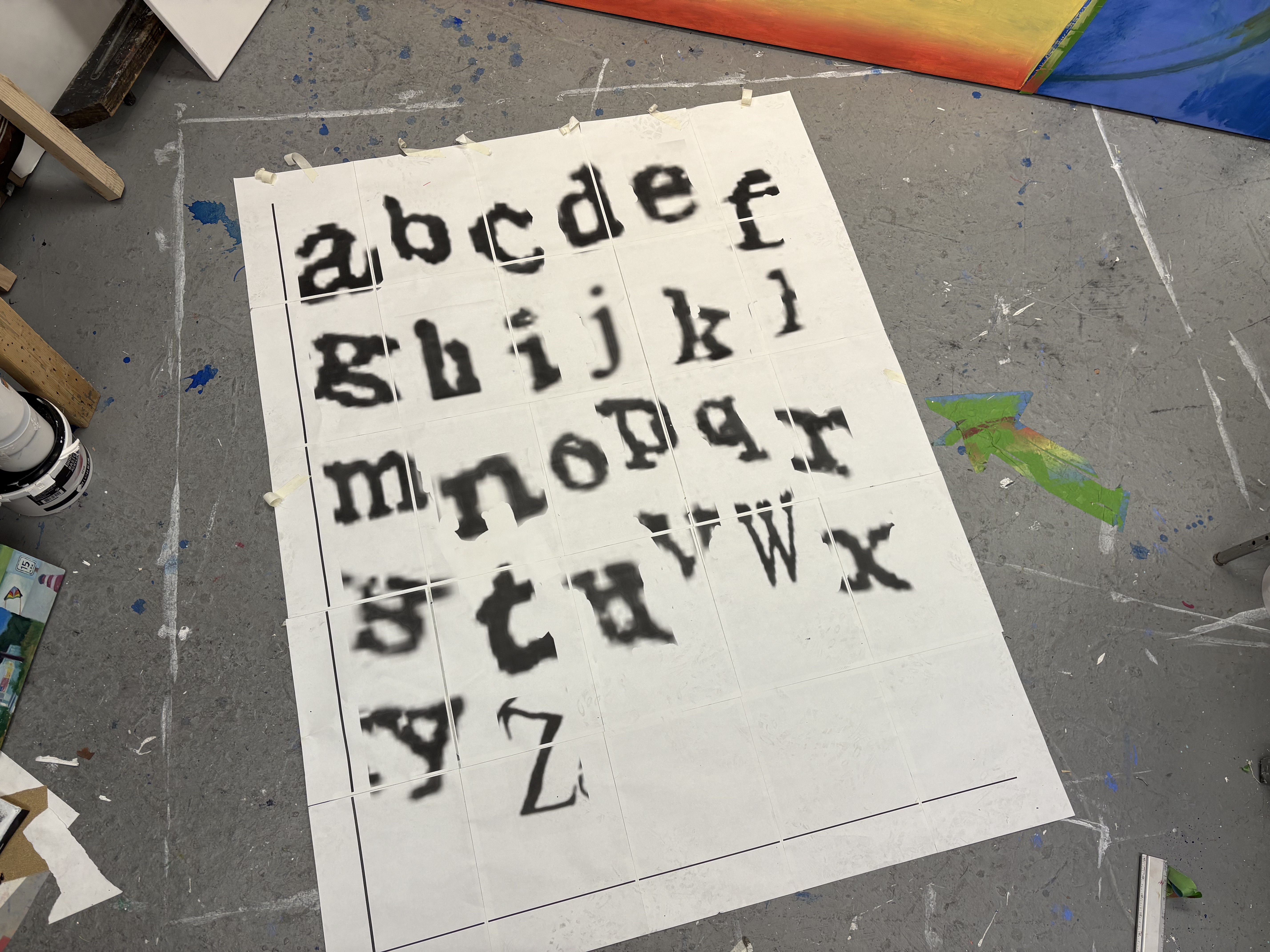
Margot motions around the studio at gridded canvases and paper scraps drawn on with stitch-like markings. A giant printout collage of a blurred and distorted alphabet lays out in front of one of the canvases.
HD What’s this on the ground?
MP I had all these index cards and I wanted to make a group of something and I was thinking, “Okay, what can I make with an index card?” I was thinking about flashcards and studying. Then, I was thinking about how AI was trained on CAPTCHA tests, like somehow analyzing how humans responded to CAPTCHA tests so it could mimic that. Then I was like, okay what would it look like if there was like a physical thing that a physical AI had to study with? I found this Reddit thread of all these people talking about getting impossible CAPTCHA tests. What would basically happen is that they would install a VPN, and then the browser, like Google or whatever, to combat the VPN, would give them CAPTCHA tests that were unsolvable.
Margot shows me pinned index cards, each with a hand-drawn CAPTCHA test.
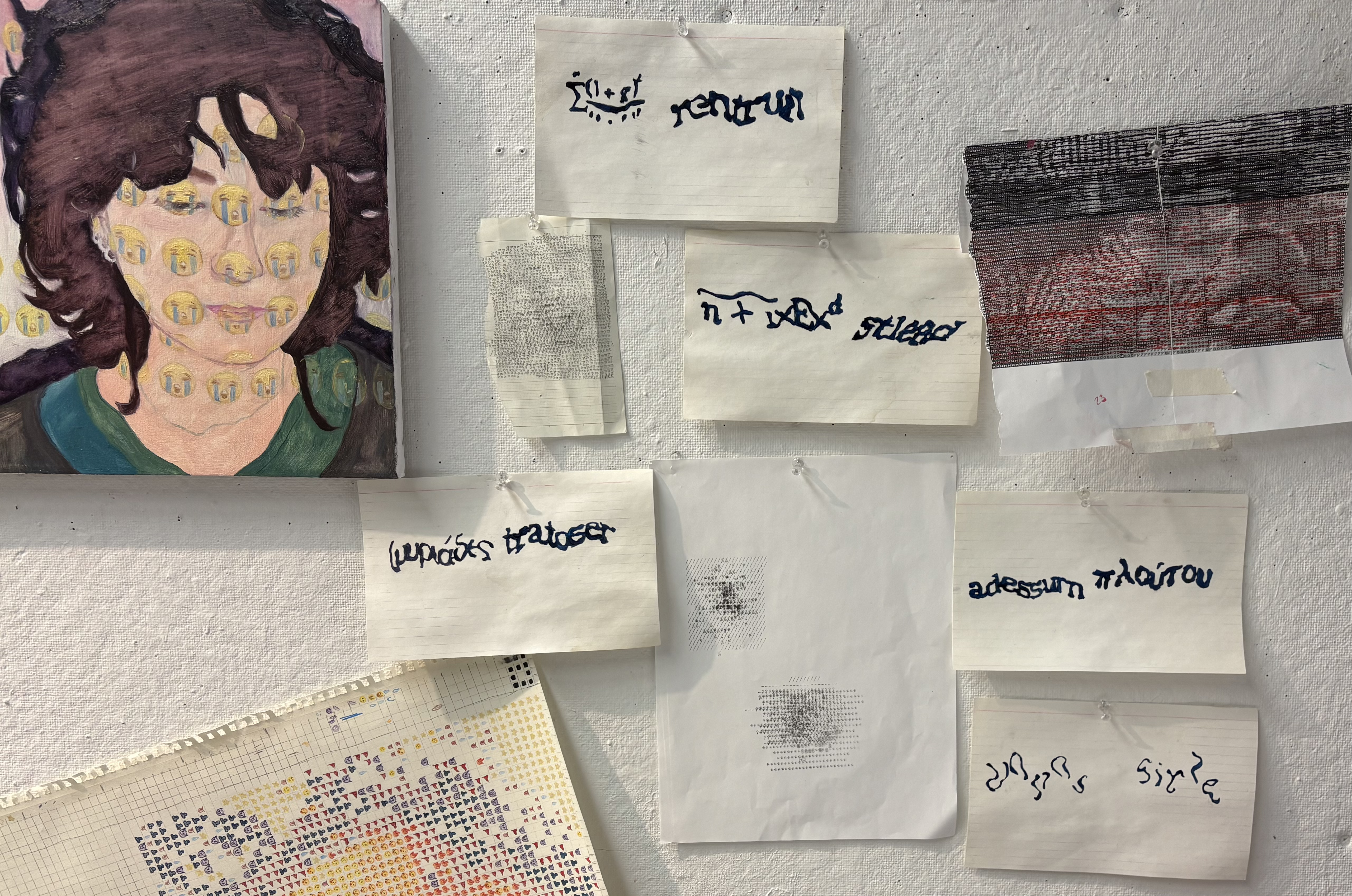
MP So my index cards are of unsolvable captions. It’s either like the symbol doesn’t exist or you can’t type it or you can’t even make out what it is. When I was making these, I was like “What is the answer?” Like the answer for a flashcard. So I made what is essentially an alphabet. The idea is that this is supposed to aid you in finding an answer but it really wouldn’t really help.
HD Is that something you’re interested in? Legibility and understanding?
MP I think so, yeah. There’s a timeliness to it or something. These symbols would resonate to people of a certain age or within a certain generation. If I showed that to my grandparents, would they read it or would they understand it the same way you would understand it? I’m thinking about how legible things are or how legible I want them to be. Like even the symbol of the cloud. I’m kind of assuming that people can read and understand that. But I guess there are people that wouldn’t.
HD It feels like you’re translating again. Taking symbols and redefining them or reusing them.
MP Yeah, for sure. I’ve also been doing these typewriter drawings. I don’t have one here, but I love my typewriter at home—like a super old, ’70s typewriter. I got this book a couple months ago from the library of typewriter drawings. It’s basically ASCII art. But typewriter art predates ASCII art. I was like, dang I have a typewriter at home. So I went home and made drawings.
ASCII art is the practice of creating text-based images from the 128 characters defined by the American Standard Code for Information Interchange (ASCII).
HD For such an intensive practice, do you do anything outside of studio that helps you think through your work?
MP I like to read. I feel like that definitely helps inform what I do here. I like to go on walks and listen to music, which I think is very simple but grounding. Sometimes you spend too much time in the studio and it feels like this is the whole world. Sometimes I just need to remind myself that the world is bigger than this little corner. Or talking to my brothers—I have four brothers. I especially like talking to my younger brothers. Since I don’t have access to a typewriter and I want more typewriter drawings, I called them and I was like “I need you guys to make so many typewriter drawings.” It’s so interesting to see what they make and what they define as a drawing. It’s interesting to hear what they think. They just think simply about things.
The sun sets as I leave. The sky’s tones of blue and purple look strikingly similar to Margot’s paintings.
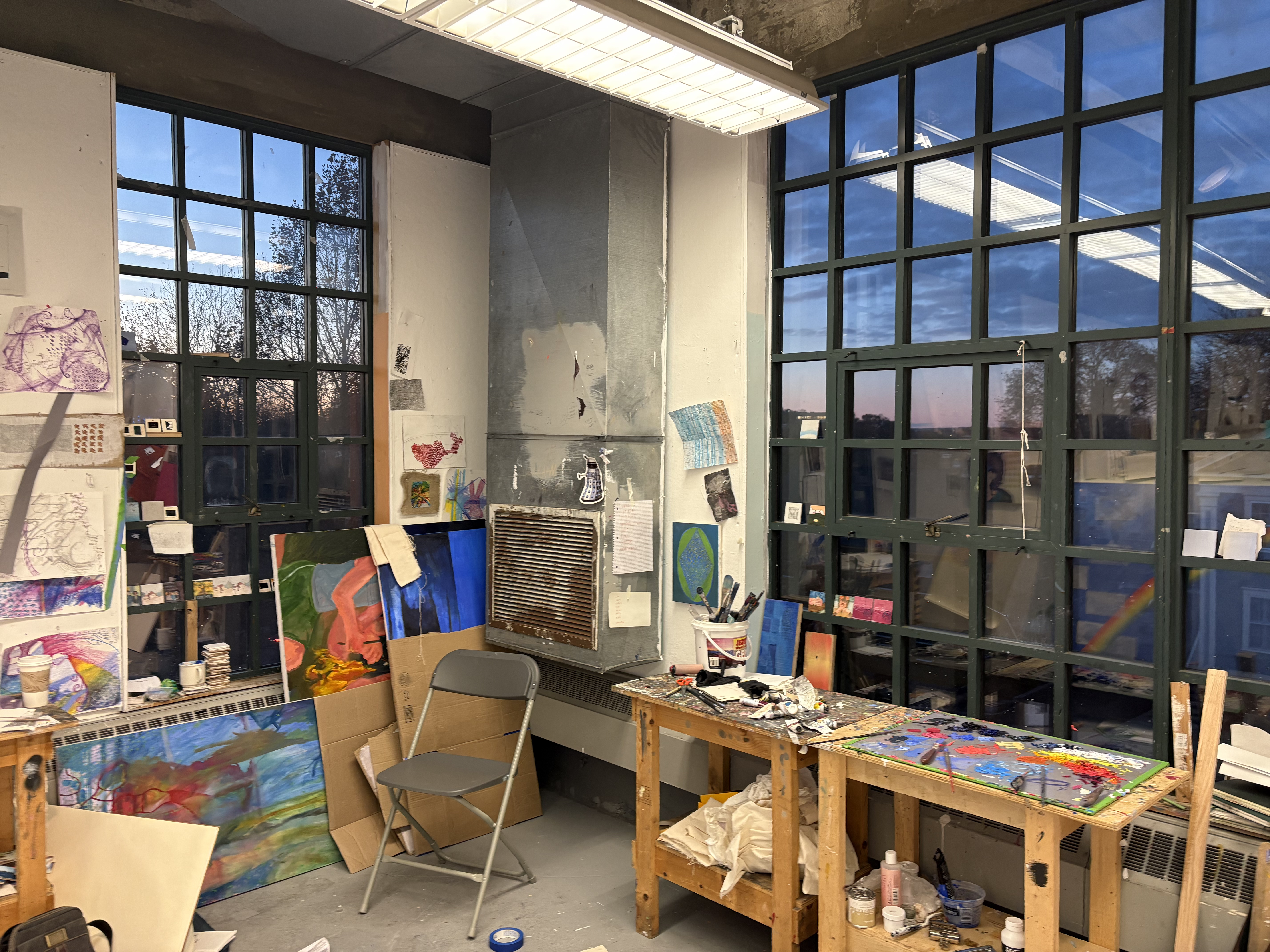
Margot Peer needs to organize her desktop.