
↳ Mission & Values
↳ Meet the Editors
↳ Submit!
Fall 2025
Spring 2025
Winter 2025
Archive
Follow Us
Office Hours: A Summary
Raúl Falcon
→BFA ID 2026
These reflections emerged from my “office hours,” where I walk and record myself speaking as if I were on a podcast. Ideas often surface, crystallize, and settle during my walks along the Providence River on my way to Whole Foods, CVS, the Nelson Fitness Center at Brown University, and the Brown Medical facilities.
I
![]()
Spinosaurus Intraspecific Combat, 2025, Digital Illustration/Pixel Art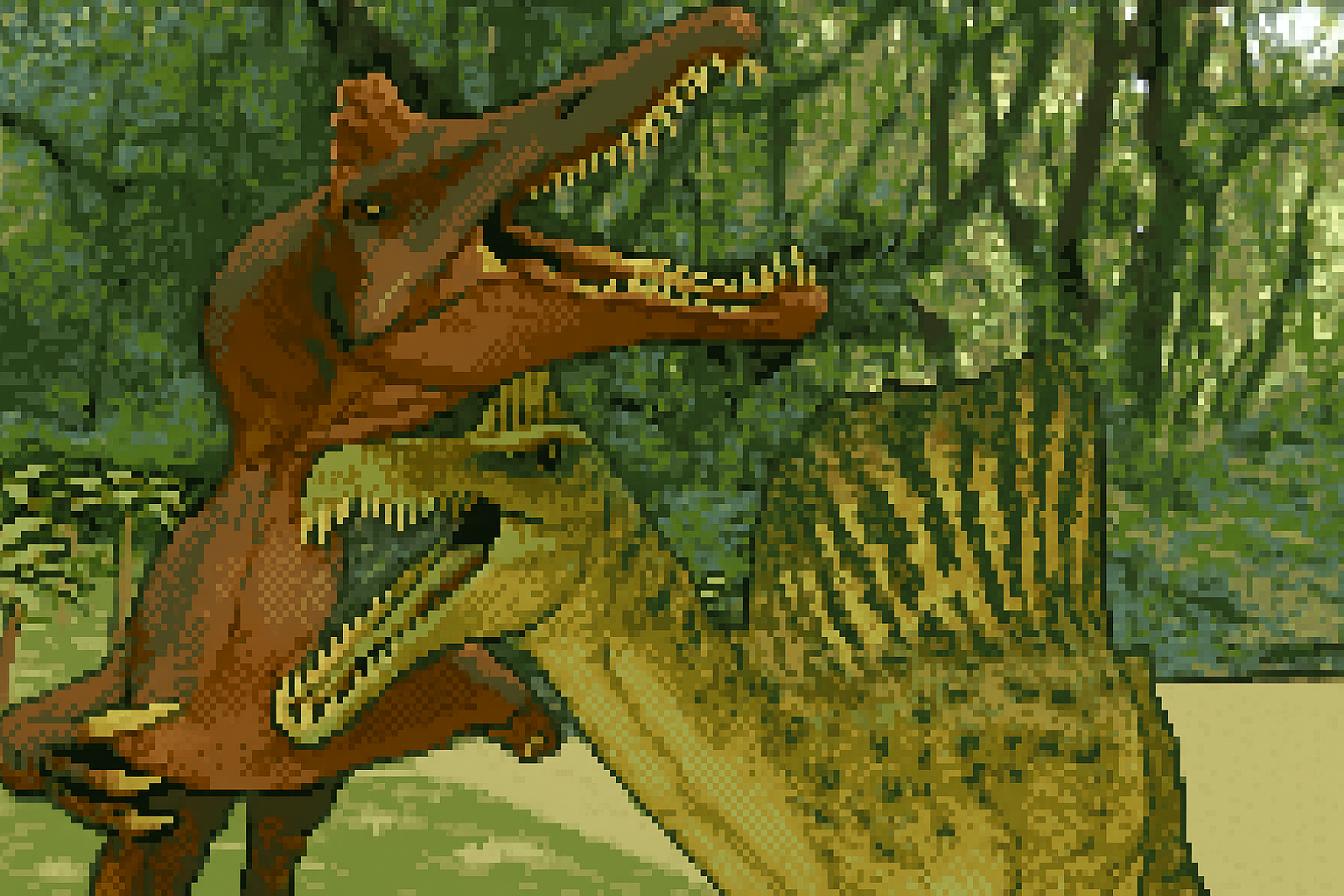
Dinosaurs present collective culture’s awe for prehistory. They are “real-life dragons” that harmonize with the constraints of physics: crocodile-like skulls in spinosaurids adapted for waterways; carcharodontosaurids with “shark-toothed” blades to slice through prey; long-necked titanosaurs like Patagotitan; and hadrosaur crests, like that of Parasaurolophus, which sounded like alto brass instruments, resonating deep, horn-like calls. They’re charismatic megafauna for the mind, especially for kids who learn that all the ideas we consider myths can be formalized and measured in the real world with science. What a perfect gateway into scientific literacy!
II
Science communication, otherwise known as SciComm, has been staging a synergy of curiosity and constraint for centuries, and was one of my strongest childhood influences. The Christmas Lectures of the Royal Institution of the United Kingdom began in 1825 to translate frontier physics and chemistry for the public; Michael Faraday’s “Chemical History of a Candle” still stands as strong demonstration material. Today’s version of science communication is people visiting a museum talk one day and watching a YouTube explainer video the next, which is why debunking Atlantis and Netflix-sanctioned pseudo-archaeology is part of the present-day science communicator’s job.III
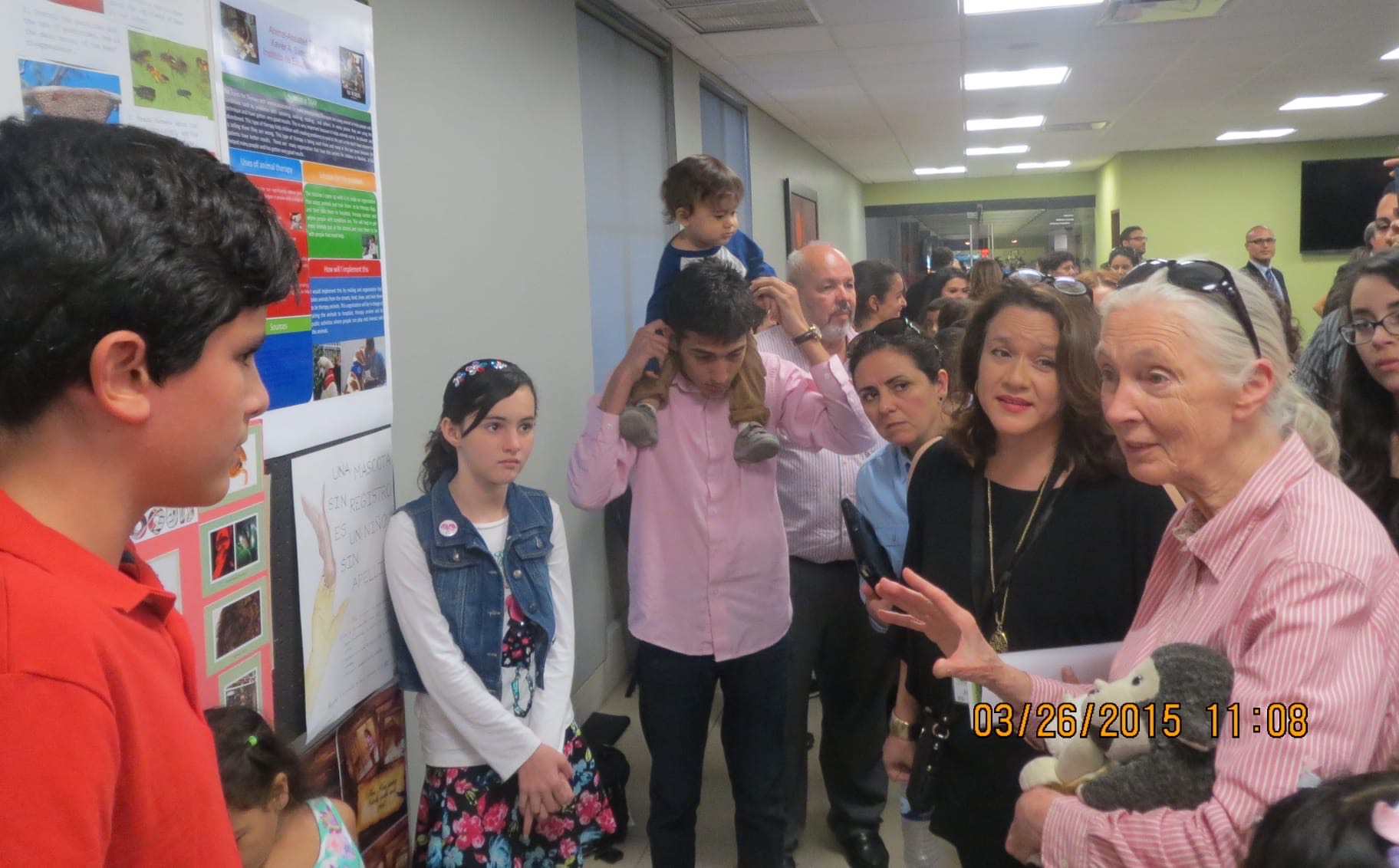 Jane Goodall and me during a student project conference. 2015, photo
Jane Goodall is a British primatologist and conservationist known for her groundbreaking research on chimpanzees, her lifelong advocacy for the environment, and her ethical approach to observation. I met this iconic scientist when I was thirteen, after being selected to join a group of young researchers working on grassroots community projects in San Juan, Puerto Rico. My project was about the ubiquitous beehives present in the area. I was hyped to talk about bees, climate, and how small community projects might scale. With her advice, we started an actionable grassroots organization advocating for climate and conservation biology. I was incredibly sad and shocked when she died on October 1, 2025. I remain fond of her legacy and grateful for all that she allowed us to see in the world shaped by our understanding of nature. Communicate, leverage the scientific method, invite people in, and keep moving.
IV
Artificial intelligence (AI) now shows up everywhere, serving as a study buddy, work assistant, and therapist. ChatGPT alone has hundreds of millions of weekly users. OpenAI’s own posts cite ~700–800 million weekly users in 2025. That usage reflects a broader transformation for many tasks. We now ask chat agents what we once typed into search engines. Ambitions continue to expand toward artificial general intelligence (human-level) and even artificial superintelligence (beyond-human). For instance, the paper clip thought experiment imagines an artificial intelligence that is programmed to make paperclips that, without ethical limits, consumes all resources on Earth to maximize production. This shows that when we optimize the wrong thing without ethical constraints, curiosity can be misconstrued. Meanwhile, the game of optimizing for the correct metric is a job for millions.
V
The attention economy is the new lifeblood of content creation. YouTube draws roughly 2.5–2.7 billion monthly active users; optimization requires rules, and creators learn them by iteration. MrBeast, a YouTuber with 400M+ subscribers in 2025, is a masterclass for packaging. He emphasizes a high-stakes premise, leverages clean visuals and editing, and has strong payoffs—all too proven off a formula. But YouTubers get loyalty when video thumbnails match the promised content. When you deliver the whole thing—question, method, and payoff—the audience has a reason to watch your video. This is precisely where science communication and design converge: you have to build the thumbnail that earns the click, then the structure that rewards the click with attention. But not everything is about the attention economy.
VI
The ketogenic diet is a high-fat, low-carb diet, which shifts metabolism toward fat-derived ketones instead of glucose. I first saw it in Joseph Mercola’s Fat for Fuel (2017), then learned the diet’s older history: a century of use for epilepsy, often delivering seizure reduction when drugs are unable to. In 2022, Chris Palmer came up with a bolder thesis, the “metabolic theory of mental illness,” arguing many psychiatric disorders share metabolic drivers and may respond to metabolic therapies. A 2025 study at Ohio State University tested this on college students with major depression: a 69% reduction in self-reported depression, a 71% drop in clinician-rated scores, nearly three-fold gains in overall wellness, and no symptom relapse during the trial. Food choices, mitochondria, and mood became suddenly connected, and testable. VII
The natural world is constantly publishing. From fossils in rock to ketones in blood to CO₂ in air, there is data intersecting in every interaction. How can we make ethical and sustainable decisions with all these gifts of nature? Our job is to publish back with the greatest faith and sense of ethics. In my own work, I’ve produced hour-long documentaries on dinosaurs, tracked my sleep performance for 338 days, maintained extended periods of nutritional ketosis, and used AI as an amplifier of intellect. If childhood fascination with dinosaurs can morph into adult passion for scientific methods, if trombone crests and metabolic mitochondria, paperclips, lectures, and thumbnails can live together, we’ve fulfilled our purpose. This is just the beginning.